VS-12-48VDC Battery Room Exhaust Fan
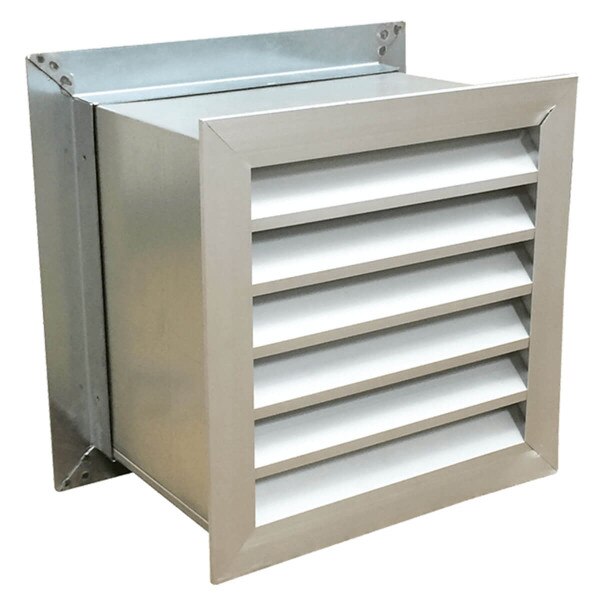


Overview
The VS-12-48VDC Battery Room Exhaust Fan is a 850 CFM forced fan system used in battery charging rooms and other locations where motive power and stationary batteries are present. The VS-12 can also be used where there is a possibility of other flammable or toxic gasses accumulating in a confined spaced. It is designed to be used in conjunction with the Eagle Eye HGD-5000 hydrogen gas detector. The VS-12 combined with the HGD-5000 provides an all in one package ideal for remote and other locations requiring a low-cost, easy to install system.
Features
- 850 CFM wall mounted fan
- Powered dampers
- Designed for use with hydrogen gas detectors, including the
- LED status display
- Motorized dampers locked when open or closed
- Simple installation with sliding collar to fit different wall thicknesses
- Long operating life
- Available in 120 VAC and 24 or 48 VDC versions
- 20-gauge galvanized steel
- Insurance premium reduction may be realized
Specifications
| Mounting Requirements | Opening: 311 x 311 mm (12.25 x 12.25 in.) Wall thickness: 38 to 203 mm (1.5 to 8 in.) |
| Dimensions | L x W x H: 241 x 305 x 305 mm (9.5 x 12 x 12 in.) |
| Power Requirements | 48 VDC, 1.7A |
| Airflow | 850 CFM |
| Optional | Reversed fan for use as forced air |
Resources & Support
Product Literature
Support Documents
Technical Information
FAQs
What does the VS-12 do and when does it turn on?
The VS-12 is a wall-mounted exhaust fan that pairs with Eagle Eye’s HGD-Series—or any compatible hydrogen detector with relay output—to provide demand-controlled ventilation in battery rooms. A common best-practice configuration is to initiate ventilation at 1% H₂ (≈ 25% of hydrogen’s 4% LEL) and trigger audible/visual alarm at 2% H₂ (≈ 50% of LEL). These early setpoints create wide safety margins below flammability while helping facilities document code-aware control logic.
Compliance note:
This control-on-demand approach helps support compliance strategies typically referenced by Authorities Having Jurisdiction (AHJs), including NFPA 70 (NEC) Art. 480 for storage batteries and—where a classified location is required—NFPA 1/IFC ventilation provisions for battery rooms; and design guidance from IEEE 1635/ASHRAE 21 (ventilation & thermal management) with maintenance practices from IEEE 1187/1188/1189. Always follow stamped drawings, verify equipment listings/labels, and perform commissioning and periodic functional tests (detector relays → VS-12 fan/actuator) per AHJ-approved plans.
What models and power options are available?
The platform is offered in multiple power variants:
- VS-12-110VAC (nominal 110/120 VAC), typical draw ≈ 0.67 A (≈80 W)
- VS-12-24VDC (≈3.5 A) and VS-12-48VDC (≈1.7 A)
How much airflow does it provide?
- VS-12-110VAC: up to 1050 CFM
- DC powered versions up to 850 CFM
What are the cutout and mounting details?
- Wall opening: 12.25 in × 12.25 in (311 × 311 mm)
- Wall thickness: 1.5 to 8–10 in (38 to 254 mm), with a sliding collar to fit the range
- Overall (L × W × H): approx. 9.5 × 12 × 12 in (241 × 305 × 305 mm)
Can it be factory-configured to blow air into the room (make-up air)?
Yes. The fan can be ordered in a reversed configuration for forced make-up air when required by the ventilation design.
How does the VS-12 series support codes and compliance?
- Integration with gas detection: The fan is designed for use with explosive/toxic gas detectors (Eagle Eye HGD-Series or any other series), enabling automatic, demand-based ventilation rather than continuous exhaust—an approach commonly used to support compliance strategies for battery rooms.
- Component approval: UL approval/listing of the fan/motor; prior FAQ references UL, RoHS, and TUV compliance for the motor and a non-incendiary design. Verify applicable markings on the delivered unit and in the latest datasheet.
What features improve safety and installation?
- Motorized internal dampers that lock when open/closed and fixed external rain louvers improve weather resistance and help keep untreated outside air out when not ventilating.
- Sliding collar simplifies installation across a wide wall-thickness range.
What periodic maintenance is recommended?
Perform regular visual inspections (e.g., verify louvers/dampers are unobstructed) and use the test function to confirm relay operation.
What is the expected service life?
Indicative values from the existing FAQ: ~10,000 hours for the fan and ~100,000 cycles for the damper actuators (site conditions and duty cycle dependent).
Does the VS-12 help reduce operating costs?
Yes. By running only when gas is detected (instead of continuous ventilation), facilities can reduce energy use while maintaining safety margins—especially valuable in temperature-controlled rooms.