VGM-100 Voltage & Ground Fault Monitor: 24V
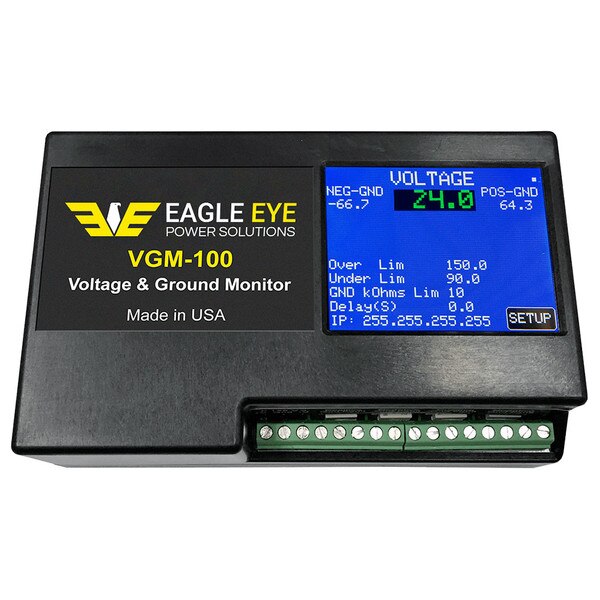
Overview
Engineered for critical 24‑volt DC applications—substations, switchgear rooms, telecom shelters—the VGM‑100 gives you round‑the‑clock visibility into both bus voltage and elusive ground‑fault leakage. Its color touchscreen makes setup intuitive: set trip points, delays, and IP settings in seconds. Ethernet connectivity, Modbus TCP/IP output, and four Form‑C contacts integrate cleanly with SCADA, PLC, or BMS platforms, so alarms never go unnoticed.
Installation is fast: mount the compact unit on a DIN rail or wall (kit included), land two sensing leads on your 24V battery bus, power the monitor from the same string, and you’re done—no auxiliary supply required. The VGM‑100 meets IEEE/ANSI C37.90a noise‑immunity standards and operates from 0–55°C, ensuring reliable performance in harsh substation environments.
For a rugged, budget‑friendly path to 24‑V battery confidence, the VGM‑100 delivers the protection and data you need—without the complexity you don’t.
Features
- Color touchscreen simple interface
- Ethernet connectivity to web interface, (4) Form C Contacts
- Modbus TCP/IP output for all measured parameters
- Simple installation with mounting kit for DIN rail or wall mount
- Monitors 24V batteries
- Configurations available for different needs
Specifications
| Measurement Range | Battery Voltage: 18‑32 Fault Resistance Limit Set: 1 – 100 kΩ |
| Fault Resistance Limit Set | 1 – 100 kΩ |
| Output Contacts | (4) Form C |
| Contact Rating | 125 VAC/VDC: 0.5 A 30 VDC: 2 A |
| Maximum Switching Power | 60 W |
| Power Requirements | Powered by connected battery DC voltage |
| Noise Immunity | IEEE/ANSI C37.90a‑1989 compliant |
| Time Delay to Alarm | Adjustable 1 – 999 seconds |
| Operating Environment | Temp 0 – 55 °C (32 – 131 °F); Humidity 0 – 95 % RH |
| Dimensions / Weight | 147 × 91 × 45 mm (5.77 × 3.56 × 1.77 in) / 284 g (10 oz) |
Resources & Support
Product Literature
Support Documents
FAQs
How does the VGM detect ground fault conditions?
DC ground fault detection is determined by measurement of the voltage imbalance relative to ground. These measurements are made through very high resistance divider networks. One establishes the ground reference, and the other measures the positive and negative DC voltages. These values are applied to analog-to-digital converters, and the microcontroller firmware compares the sum of these DC values to the ground reference. If the sum is 0, the DC voltage is perfectly balanced relative to ground. If the sum is positive or negative, the DC voltage is unbalanced positive or negative. User settings determine the extent of imbalance that will result in an alarm condition.
Will the VGM detect a ground fault via a leaked battery jar?
The system will detect a ground fault caused by a leaking battery jar provided the ground-fault-resistance setting is configured correctly. Because a leak creates a resistive path to ground, the VGM senses the resulting voltage imbalance and triggers an alarm as long as the path-to-ground resistance is lower than the set threshold.
What is the k ohm limit for ground detection?
Up to 300 kΩ.
What are the contact ratings for the Form C contacts?
The relays are rated at 60 W with a maximum of 220 V DC and 2 A. Practically, they can switch 2 A at 30 V DC or less, 0.5 A at 125 V DC, and only 0.009 A at 220 V DC. Use an external relay if higher ratings are required.
Do the connections between the monitor and the batteries need to be fused?
No. The monitor includes an internal fuse for self-protection. You may still choose to fuse the external wiring to guard against short circuits.
Is the VGM CSA certified?
The VGM-Series is CE certified. For Canadian customers, CSA certification is not required for DC-powered units. Contact Eagle Eye for clarification on specific certification needs.