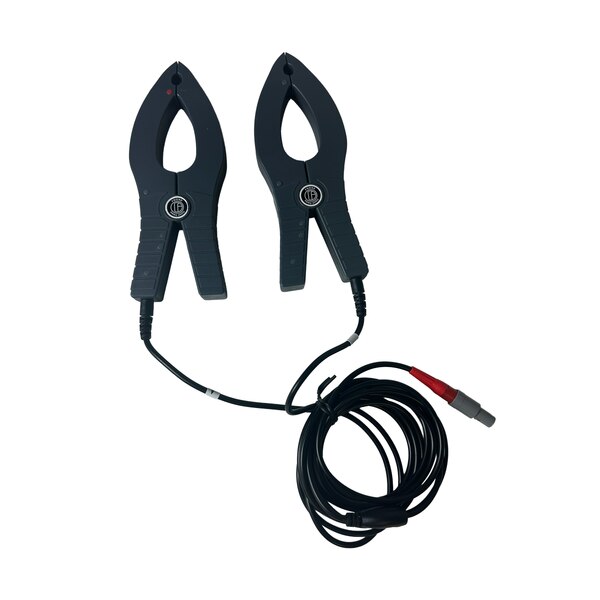
GFL-1000-CC Dual Clamps Set

Overview
Unlock faster, more confident troubleshooting with the GFL-1000-CC Dual Clamps Set—a matched pair of clamp-on current sensors designed to work with the . By measuring and comparing current on two parallel conductors or feeders at the same time, the dual-clamp method helps you quickly identify the path of least impedance and zero in on the circuit segment that’s leaking to ground. The result is a shorter hunt, fewer lift-and-isolate steps, and less downtime for critical DC systems.
Unlike single-probe tracing, dual clamps let you perform A/B comparisons in real time—ideal for complex battery rooms, telecom plants, and substations where multiple feeders, return paths, or long runs can mask the true fault location. Because the clamps are non-intrusive, you can trace and verify without disconnecting conductors or taking equipment out of service, maintaining safety and continuity while you work.
Built for field conditions, each clamp offers a durable hinge and smooth jaw action for quick placement in tight panels or crowded cable trays. The set integrates cleanly with the GFL-1000 transmitter/receiver workflow, helping you move from “fault present” to “fault found” with fewer steps. Technicians appreciate the repeatability: when both clamps show distinct differential readings as you move downline, you know you’re closing in on the faulted branch.
Key Benefits
- Faster fault isolation: Side-by-side current comparison reduces guesswork on complex runs.
- Non-intrusive testing: Clamp around conductors—no disconnects or service interruptions.
- Cleaner workflow: Works directly with GFL-1000 transmit/receive methodology for clear go/no-go decisions.
- Field-ready design: Rugged construction for utility, industrial, and telecom environments.
- Safer, more precise tracing: Minimize unnecessary panel access and repetitive lifts.
Typical Use Cases
- Tracing ground leakage on multi-feeder DC distribution
- Verifying suspected branches in large battery strings
- Narrowing fault zones across long cable runs or parallel paths
- Pre-maintenance checks before isolating equipment
Best-Practice Tips
- Start at the source and move outward, placing both clamps on candidate conductors in the same section to compare readings.
- Advance one clamp downstream while leaving the other as a reference—follow the higher reading toward the fault.
- Keep clamps centered and fully closed on clean, separated conductors for consistent results.
- Use with appropriate PPE and follow site Lockout/Tagout (LOTO) procedures.
Compatibility
Purpose-built for the . If you’re running mixed accessories, confirm your clamp connector type and input range match your GFL-1000 kit.
Note: The set includes two clamp-on current sensors matched for comparative tracing. For a complete list of included accessories (leads, pouches, adapters) or electrical ranges, or your GFL-1000 kit documentation.
Features
- Matched pair of clamp-on current sensors for comparative tracing
- Purpose-built to work with the
- Real-time A/B current comparison to quickly pinpoint leakage paths
- Non-intrusive testing—no conductor disconnects or service interruptions
- Rugged, field-ready construction for utility, industrial, and telecom sites
- Low-profile clamp design for tight panels and crowded cable trays
- Smooth, secure jaw action to ensure consistent, repeatable measurements
- Streamlined workflow integration with GFL-1000 transmitter/receiver methodology
- Speeds troubleshooting, reducing lift-and-isolate steps and downtime
- Ideal for tracing faults across multi-feeder DC distribution and long runs
Resources & Support
Product Literature
Support Documents
FAQs
What is the GFL-1000-CC Dual Clamps Set used for?
It’s a matched pair of clamp-on current sensors designed to work with the . Using both clamps at once lets you compare current on parallel conductors or feeders to quickly identify the path with leakage to ground.
Why use two clamps instead of one?
Dual, side-by-side measurements enable A/B comparisons in real time. This reduces guesswork on complex runs, highlights the branch with higher fault current, and shortens the time to isolate the faulted section.
Can the clamps be used without the GFL-1000?
No. The set is intended to integrate with the workflow. It is not a standalone measuring instrument.
What types of systems is it best for?
DC battery strings and distribution in substations, telecom plants, UPS rooms, and industrial control systems where multiple parallel feeders or long runs make ground faults hard to trace.
Do I need to disconnect any conductors to use the clamps?
No. The clamps are non-intrusive—just clamp around the conductors. This minimizes downtime and avoids unnecessary panel work when tracing leakage.
How do I position the clamps for best results?
Start upstream, place both clamps on candidate conductors in the same section, and compare readings. Move one clamp downstream while keeping the other as a reference. Follow the higher or changing differential toward the fault.
What conductor sizes will the clamps fit?
They are designed for common DC distribution conductors in battery rooms and telecom environments. Verify the jaw opening and conductor insulation diameter in the product specs to ensure proper fit before field use.
Are the clamps rated for AC as well as DC?
The application focus is DC ground fault location with the methodology. Check the electrical specifications for AC response and frequency limits if you plan to use them in mixed environments.
Do the clamps require calibration?
They are shipped matched for comparative measurements. Follow your site’s maintenance program; periodic functional checks against a known source are recommended for quality assurance.
What comes in the box?
The set includes two matched clamp-on current sensors.
How durable are the clamps in field conditions?
They feature rugged hinges and a low-profile body for tight panels and trays. As with all precision sensors, avoid dropping, crushing, or exposure to harsh chemicals; store them in a protective case when not in use.
Can I use the clamps on bundled or tightly spaced cables?
For accurate comparative readings, clamp each sensor around a single, isolated conductor. If cables are bundled, separate them enough to get a clean, centered clamp around each target line.
What safety precautions should I follow?
Treat all conductors as energized. Wear appropriate PPE, follow site Lockout/Tagout (LOTO) and arc-flash policies, and use only on insulated conductors within the clamps’ electrical ratings.
How do I interpret a clear difference between the two clamp readings?
A higher or changing reading indicates the direction of the leakage path. Continue stepping downstream with one clamp while keeping the other as a reference until the difference narrows to a specific branch or segment.
What if both clamps read nearly the same?
Move upstream or choose a different pair of conductors. In some segments current may be balanced or the fault may be beyond your current test point. Reposition and repeat to refine the search.
Is training available for new technicians?
Yes. .
What warranty and support are available?
Standard manufacturer warranty applies; support is available through Eagle Eye Power Solutions. Keep your proof of purchase and .